Search This Blog

Tuesday, January 16, 2007

Shallots potted up


I potted up my shallots at the weekend. Each one is planted in a 3" pot of 1/3 sterilised topsoil and 2/3 multipurpose compost with added seaweed and superphosphate. They were given a quick watering and put into a cold greenhouse where they won't now be watered again for several weeks as I want them to make good roots that fill the pot. At that point I will pot on into larger pots (probably 5 or 6").

Last year I actually buried these pots into the borders rather than planting them out into the soil. The roots grow through the bottom of the pot and into the soil below. I found this made the job of thinning out and subsequent harvesting easier. As soon as the shallots start to divide you need to thin them out (very carefully) to leave only 2 thinnings to grow on. It's quite a fiddly job, but the two that are left have room to develop into nice, large rounded shallots that look good on the show bench. This usually takes place in early May, and I'll discuss that further nearer the time.

The thinnings you take off can be planted elsewhere and will grow on to give small pickling shallots also.

Tuesday, January 09, 2007

Growing Cabbages for show


The cabbage class at most shows is fairly well supported as most people grow a row or two. But to win the class you will need to exhibit a reasonable sized, solid-hearted, matching pair with little or no sign of pest damage. After planting out your young plants in Spring and taking the usual precautions against cabbage root fly (whether it be dusting the stems at soil level with an insecticide or wrapping a carpet disc around it) then you may want to think about covering the plants completely with some heavy duty netting as shown above. This has two advantages.....first it prevents pigeons nibbling the young plants and later in the summer it helps keep off the cabbage white butterflies. However, vigilance is still required as the latter has a knack of somehow managing to get through the netting and laying the odd patch of eggs.

The netting I use was discarded from a building site and will last for many, many years.

I've also found that it helps to maintain a lovely deep green bloom as the sun doesn't seem to bleach them under their semi-shaded canopy.

On the morning of the Show cut at ground level to give a stalk at least 80mm long and snap off any old, yellowing or damaged foliage. Transport carefully to the show and display simply side-by-side on the show bench facing forwards. Try not to touch the head to spoil the 'bloom' and make sure their are no rogue slugs or caterpillars lurking amongst the foliage. The judge would not be impressed in close competition and may well use that as a reason to downpoint you.

Saturday, January 06, 2007

Growing carrots and parsnips for show


If you’ve ever been to a flower and vegetable show and wondered how the growers get their carrots and parsnips 4’ long then here is how it is done.

The secret is to get hold of some old oil drums or barrels, cut out the tops and bottoms and fill them with sand. 5 or 6 conical holes 3”across at the top are bored into the sand with a stout metal rod. The growers ‘special’ mix is sprinkled into the holes. In actuality this is nothing more than sieved compost/garden soil/vermiculite with a few ounces of fertilizers such as superphosphates and calcified seaweed. (I'll talk about this more during March and April when I do mine)

Around the middle of April a few carrot seeds are sown into a small indentation at the top of the compost ‘cone’ and covered. After 3 or 4 weeks when the seedlings are growing away, select your strongest seedling and cut the rest out at soil level.

A pane of glass over the top of each drum is necessary to stop cats digging in the sand (bless em!) and watering should be done sparingly in the early days to just keep the top surface moist. Once the carrots are well established the moisture in the sand should be sufficient and many growers cover them over from July so that no water gets to them whatsoever, thus encouraging the roots to go down in search of moisture.

There is no feeding required during the season as there should be sufficient fertilizers in the ‘mix’. However, a foliar feed can be given at intervals such as phostrogen.

Extracting the roots on show day is the moment of truth. If everything was prepared properly all those months ago you should have long, tapering roots that look superb on the show bench. It can take 20 minutes to get each one from its ‘station’ intact…you want to get as much of the fine tap root up as possible so a lot of care must be taken. A soft sponge and clean water should be used to clean them carefully and all the fine root hairs should be removed. Reduce the foliage to 75mm if the schedule asks for it and display side-by-side on the show bench. Then all you have to do is await the ‘red card’.

The carrots shown above are from the National Vegetable Society Midland Championships held at Malvern at the end of September, grown by Jack Arrowsmith who manages to grow huge roots about 6' long. You don't have to get them this long or big but with a little effort you can achieve 3 to 4' quite easily.

Why not have a go? You’ve got the rest of the winter to get everything ready!

Wednesday, January 03, 2007

Happy New Year!


Just back from spending Christmas in the Lakes where I took the attached photo on a walk up Swirl How. It's Pike O'Blisco sticking up through the mist covering the valley floor. If you've never been to the Lakes then do yourselves a favour and go ! It's the most beautiful place on Earth I reckon and right on our doorsteps.

Back home and the garden's been absolutely hammered by rain so it's impossible to do anything outdoors. Most seeds have arrived and I'll be doing my compost mixes for the parsnips and carrots over the next few weeks. I shall also be doing a scale plan of my garden and working out exactly what goes where and when so that I only grow what I need and what will actually fit! (That's the plan anyways).

Tuesday, December 12, 2006

Growing beetroot for show


At most shows the beetroot class is well contested as everyone seems to grow it. But you need to know a few things to be able to win the class.

I sow several rows spaced a week apart from early May until the beginning of June. This allows me to cover the show period from late August to early October. If you choose a monogerm variety such as Red Ace then there is less need for fiddly thinning. Most beetroot varieties are actually seed clusters that can result in 3 or more seedlings coming through.

The rows need to be well watered during the summer and not allowed to dry out as this can cause corkiness around the shoulders. To prevent this the whole shoulder needs to be regularly covered over with moist soil, but this can be laborious and in any case there is a way of combatting this during the washing process (see below).

I read somewhere that the internal colouring of beetroot can be inproved by the addition of salt in the watering can. I don't know if this actually does help but it certainly hasn't caused any harm when I've tried it.

I like to lift my beet a day before the show so that I'm not rushing about too much. Each root should be about the size of a tennis ball, slightly smaller preferably but certainly no bigger. And there should be a nice long central tap root coming from the exact centre of each. Sometimes these tap roots can fork a few inches down but I snip off any excess roots to give the impression of one single long tap root. Discard any specimens showing signs of slug or pest damage and retire the kitchen sink.

Wash off any loose soil under running water and scrub gently with the soft side of a scouring pad to make the root's colouring shine out, taking care when washing the tap root so as not to break it. If the shoulders are 'corky' the rough side of the scourer can be used to rub off the corkiness (GENTLY!) . It might pay to practice on some 'rejects' first!

Discard any yellowing leaves and immerse your chosen roots overnight in a bucket of cold water mixed with a few teaspoons of salt and a dash or three of vinegar. This seems to bring out the colouring of the beet but you do need to make sure you give them a good rinse before you go to the show or else the judge can smell the vinegar on them when he picks them up for closer inspection.

Bear in mind also that the judge will cut a slice out of one of your roots to check the internal colouring and to make sure there are not any white rings that denote poor watering.

At the show stage them straight onto the show bench facing towards the front, with the foliage tied neatly with string or raffia. Some shows require the foliage to be cut to a certain length and this needs to be done or else the exhibit may be marked down as NAS (not as schedule).

If you have 3 roots all the same size, with nice, bright, red/purple colouring and a nice long, straight taproot then the red card should be yours!

Saturday, December 09, 2006

Growing tomatoes for show


2006 was without doubt my best year for showing tomatoes, mainly because I gave them proper attention. I won 5 out of the 7 shows I attended from late August to early October, and the two I didn't I really felt I should have won also....but hey ho!

People are often in a hurry to sow their seed in late Jan or early Feb but mine tend not to go in until about the first week or two in March. I find this sowing date allows me to have strong plants that are ready for planting out during the first Bank Holiday weekend in May. After germinating they are pricked out into individual cells and then potted on accordingly as soon as the roots start to show through the pot they are in. This might mean they are potted on 2 or 3 times before being planted into the greenhouse border soil but it does allow you to bring them inside if frosty weather is forecast.

When planting into the greenhouse border soil, they actually get planted into a large bottomless pot filled with grow-bag compost, watered well then left for at least a couple of weeks so that the tap root goes down into the bed. This means they are less likely to suffer if you miss a watering now and again. The pots are useful for feeding as the feeder roots are nearer the surface of the compost.

A stout cane is secured next to each plant and tied to it as the plant grows. I don't feed until the first flower truss is showing small fruits, and only then every other day. I alternate with 3 feeds.....the usual proprietary tomato feeds from the garden centre such as Tomorite, and my own feeds made from nettles and comfrey. The leaves of each are chopped up and left in a bucket of water for several days and the resultant 'stews' strained off to give 2 concentrated liquid feeds. Pour them into bottles and label. A capful is put into a watering can in turn with the Tomorite.

I've heard it said that tomatoes are best watered in the early evening so that the water has time to get down into the roots and if you do cause some splashes onto the fruit then the sun is not at it's fiercest. If this happened in the morning the sun can be magnified through the water droplets and causes scorch marks on the fruit skins....leading to possible downpointing on the showbench.

One thing I shall be doing next year is the reduction of the fruit on the trusses to allow each fruit more room and to stop them having 'flat' sides. This is viewed as a fault on the showbench and again results in your exhibit being downpointed.

All being well, you should have plenty of fruits to choose from come show day, but make sure you choose 5 or 6 fruits (according to schedule) that are as alike and evenly matched as possible, and that are nicely coloured, well ripened but not overripe. Cut the stalk about 1/2" past the knuckle and pack securely in a box such as the seed trays designed to carry small plant pots. Each compartment should have some tissue paper lining to keep the fruit blemish free. Do NOT polish the fruit....but wipe off any minor marks carefully. At the show arrange the fruits around a paper plate, pop on your exhibitor sticker or card and go and have a cuppa whilst the judges do their work.

Hopefully, all your hard work will be rewarded with a 'Red Card' when the show opens. It's a great feeling.

Hurry up 2007!

Not much happening in the garden at the moment apart from tidying up still....as and when the weather allows. We've had loads of rain so everywhere is waterlogged.

I did manage to drench the beds in my two greenhouses last weekend with several buckets of rainwater. This needs to be done over winter to stop a build up of salts in the border soil which can prevent the roots of plants taking up nutrients. Some growers will remove the glass (or polythene if polytunnel) and allow the winter rains to get at the soil. However, I have some pots of show daffodils in mine and my growing cabinet will be assembled soon so that I can grow on my show leeks and onions (more of this in the New Year).

I also spread several bags of horse manure over the soil in one greenhouse and will do the other one when more is forthcoming from my daughter's friend who owns a horse. I'm intending to grow my large onions in the greenhouses next season in order to give them a more even growing cycle. They will be lifted before the tomatoes and cucumbers are too big and blocking out the sunlight (I hope).

Only other thing to tell is that all my seed orders are starting to drop through the letter box. I've ordered over £200 worth of seeds/sets/plants and spuds with quite a few new varieties to try. But I will have to do a proper 'cropping plan' so that I know exactly what is going to be planted where and when. Last season I was poking plants in where I could with no thought as to how they would grow and when they would be harvested. This caught up with me in the long-run as the season petered out disappointingly, with many crops running out of steam.

When 'growing for showing' things have to be timed to come good when you need them so you have to count back from the show date and sow/plant accordingly. Again, more of this in the next few months.

Bye for now.

Saturday, November 11, 2006

'Pointing' of vegetables


Before entering a vegetable exhibit in a Show it is important to know what a judge will be looking for. Too many people are blinded by size and will put the largest specimens into a class with no regard to other factors such as condition and uniformity. The overall quality of an exhibit should be the most important consideration to such an extent that ‘if you wouldn’t eat it don’t show it !’ Gone are the days when the biggest onions automatically won. They will if they are grown well and form a nice even set.........but your smaller ones can and should win if they are in a better condition and are more evenly matched.

The points awarded for parsnips are relevant in understanding what is required. Below are the points awarded under the guidelines of the Royal Horticultural Society and the National Vegetable Society. It is sometimes advisable to check which rules are being used for a particular Show, although for most village events it is not necessary to worry about it too much.

RHS points - Condition 6, Uniformity 5. Size and Shape 5, Colour 4, Total 20 points.
NVS points - Condition 6, Uniformity 4, Shape 4, Size 3, Colour 3. Total 20 points.

In both of the above, size is awarded relatively few points out of the total 20. With this in mind it can be seen that no-one should be put off from having a go just because they think they can’t compete with the ‘big ones’.

Parsnips are one of the '20 pointer' veg. Others are long carrots, potatoes, tomatoes, runner beans, large onions and cauliflowers. The inference is that these veg are more difficult to grow to perfection than say cucumbers (18 points), cabbages (15 points), beetroot (15 points), or 8oz onions (15 points). When a judge is comparing different types of veg in collection classes it would be very difficult, for instance, for cherry tomatoes (12 points) to beat regular size tomatoes unless the cherry toms were near perfect and the regular sized ones hadn't been grown very well, were in poor condition or were poorly matched.....but it can be done!

Presentation of the exhibit can very often make a difference. I have beaten what I would consider to be potentially superior exhibits because not enough attention was given to their preparation. This includes not washing carrots and potatoes, not taking off dead or decaying foliage and displaying an abnormally large vegetable with two other good but smaller specimens and hence losing marks for uniformity.

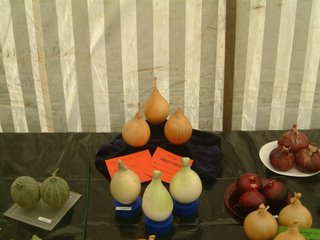
The pic above shows my winning onions at a recent show. The ones that come second each year are about 4 pounds each and many people struggle to understand how mine keep winning. But luckily the judge knows what he's doing (some don't) and recognises that the larger ones are poorly matched, badly ripened and unevenly weighted.

Read the schedule carefully before entering. Too often people will only put 5 tomatoes in a dish if 6 are asked for. If it asks for carrot foliage to be trimmed to no more than 3” then do so. A judge will be quite within his rights to award a NAS (Not as Schedule) card and first time exhibitors could easily be turned away from what can become a very satisfying and rewarding hobby.

Friday, November 10, 2006

1 flower 1 veg


Enough of football for now.....I'll spend the winter months showing different classes and how to stage in them.

A popular class at a lot of shows is the class for a single specimen flower and a single specimen vegetable. (Some shows go further and also have a single specimen fruit). They are usually very popular as most people will have a spare veg or bloom that they can enter into this class without having to match it up to other blooms or veg. However, it is important to try and select your best single flower or vegetable if you want to have a chance of a prize card.

The judge will compare your dahlia (or whatever bloom you choose) against other dahlias so it needs to be as fully developed and blemish-free as possible. Therefore, flowers such as dahlias/chrysanths and gladioli would be the best ones to go for as these are deemed harder to grow to perfection than say marigolds/sunflowers and other annuals.

Similarly, what are termed '20 pointer' vegetables such as carrots/parsnips/tomatoes/potatoes etc are looked upon more favourably than lower pointed veg such as cabbages/peppers/beetroot etc. (I will explain the pointing of veg in my next post).

The pic above shows a well contested class at Littleover Show this year. The superb gladioli and potato near the camera won.....my humble dahlia and carrot staged next to them didn't even warrant a place.

Sunday, October 22, 2006

Manchester United 2 Liverpool 0


Nowt to do with gardening but just couldn't help it...........Yeeeeeeeeeeeeeees!!!

Saturday, October 21, 2006

An experiment that failed!


Space is at a premium in my garden. Although quite large it was laid out before I got into growing for showing and so my veg plot is quite small. I've gradually grabbed bits of land from the more 'ornamental' parts but I still need to plan my growing year carefully so that I know which bits of land are growing which crops year by year. Crop rotation is a must on any plot but more so on mine where I grow so intensively.

I've never been able to devote a decent patch of land to growing celery. They like a nice deep fertile trench erring on the boggy side if anything. But they are fickle creatures and can get something called heart rot if conditions are not to their liking. I've grown them before this year in a bed made from old paving slabs on end lined with old growing bags to keep moisture in. This season however I wanted to use that bed for growing more carrots (a rushed attempt in the end that also failed) and I hit upon the idea of growing celery in large builders buckets filled with well-rotted compost and a few added fertilsers. It looked promising at the start......as you can see I had the buckets lined up in a small space next to my conservatory which is reasonably shady. They grew slowly because of the spring and a late sowing so were never going to be particularly large. But just when they seemed to be coming on they succumbed once again to celery heart rot. I use pellets so I know slugs weren't a problem.......it's thought by some that they might sometimes be responsible for introducing it.

One thing I didn't do this year is dribble a solution of calcium nitrate into the heart once a week......some think this prevents heart rot but I did that last season and still suffered from it.

So next year it's back to the drawing board. It's worth growing them when you get it right because they can look impressive on the showbench as you can see from an entry above in 2004 when I did get it right !

Wednesday, October 18, 2006

SAD !


For a number of years around about now I've started to feel quite depressed at the dying of another growing year........Seasonally Affected Disorder (SAD) I think they call it!

This year I've decided to approach things in a different manner and treat this as the beginning of another growing year by using the next few months to make sure all my preparations are carried out fully. In hindsight I now think my last season didn't fulfil the early promise because my preparation wasn't as thorough as it should have been and that things simply ran out of steam. I was doing my root mixes at the last minute and not enjoying the buzz of sowing things. This meant other things were rushed....notably my bean fence.......and the plot couldn't last the rigours of British weather. Consequently, I was spending valuable time repairing and fixing instead of tending to the plants' needs.

I also need to get some organic matter into my veg beds. It's been a few years since I did and have relied on fertilisers too much. When you grow so intensively and in a confined space like I do then the soil will eventually run out of steam so to speak. The late, cold Spring, hot summer and wet September certainly found out my failings in that department this year.

Pics above are ones of my garden in May this year.......it's nice to look at photos you took earlier in the year when it's so grey and dreary outside.

Monday, October 09, 2006

That's it!


Show season is now over and it's time to assess your growing year and make plans for next season. I won most points in the veg section at Sturton but didn't do as well as in previous years. This was partly due to the fact that my produce wasn't up to the standard of previous years but also because there were several new exhibitors this year, all with excellent veg and flower exhibits. However, it was most welcome to have new competition and I shall certainly have to raise my game next year.

This season I won 62 classes, came 2nd in another 47 and 3rd in 32. This was down on last year confirming my suspicions that things weren't as good. There were successes, notably tomatoes with which I won at 5 out of the 7 shows I entered. But my carrots were very poor and I only managed one 3rd place all season with runner beans (finally, at Sturton!). I really need to make sure I have done a lot more preparation over the winter months and that all my support structures are ready and my compost mixes prepared in plenty of time.

Lessons are learnt every season. Just when you think you've cracked something a different problem comes along to challenge you. I've always been strong on carrots, but the late cold Spring killed my initial sowings, and followed by a scorching summer the second sowings didn't grow as well as they might have.

And whilst I was giving optimum attention to my tomatoes I was failing to give the proper care to my beans. Several work-related issues also conspired against me and meant I was often working late during the late Spring and into Summer, and having 3 teenage daughters that need 'taxi-ing' to various places on a daily basis doesn't help! Most of the guys I compete against are retired and presumably have more time to devote to their hobby, although I have encountered many more people this year who are of a similar age to myself if not younger. This is encouraging for the future.

One final problem I need to solve is that of tending the plot during my annual holiday. We always go away during July and although my mother-in-law does a stirling job it's not the same as being there yourself. I returned from holiday this year to find my cabbages infested with cabbage white caterpillars and already half-eaten. It had also been incredibly hot and everything had suffered. If I had been at home I could have watered more judiciously and protected against butterflies. Oh well!

Friday, October 06, 2006

Last show of the season


Tomorrow is my last show this season at the village of Sturton-by-Stow in Lincolnshire. As I said in the previous post it's been going over 119 years and is another well-run show organised by very nice people. They always make me feel very welcome, appreciating the fact that I have to travel over 50 miles in time to get there at 7.30 to start staging.

I have to be mega-organised for this one as I put in about 60 entries, so I have to get as much stuff ready in the days leading up to it as possible. I got up bright and early yesterday morning to pick a load of dahlias as heavy rain was forecast, which could have marked the blooms. My onions and shallots are all packed, my cacti top-dressed and the pots cleaned and my marrows cut. There are some jobs such as lifting the roots and cabbages which need to be done today otherwise they won't be as fresh as possible on the showbench. I've booked the afternoon off so that I can finish everything off and get the car loaded so that all I have to do in the morning is drive off.

The last job that I always leave as late as possible is washing the spuds. These have now been out of the ground stored in my garage in pots of peat for over 5 weeks now and will not be looking as fresh as they would have done a few weeks ago. Because of this they take a bit more 'scrubbing' and can show up bruises by tomorrow afternoon when the show is open to the public. This can cause some comments from people who cannot understand why mine have won. But what you have to bear in mind is that they probably were the best when they were judged. The judge cannot judge on what they might look like in 2 or 3 hours time. Similarly, you may see dahlias and chrysanths that are falling to pieces and yet they have a prize card against them. In those instances the exhibitor only just got away with it and staged his blooms at the last possible moments of their perfection before they started dropping petals. Seems unfair but that's 'showing' for you!

Pics above are one of me at a previous Sturton Show and one of my winning spud entries.