Search This Blog

Showing posts with label Malvern. Show all posts

Wednesday, June 28, 2017

Too late now!


In life you are often faced with situations that seem at first glance to be one thing, which may look quite threatening, but in actuality turn out to be something totally opposite and entirely benign. For instance, (and I use this example and location entirely at random) if you saw a group of middle-aged white people in a field below the magnificent Malvern hills, standing around a table full of fruit cakes, your natural reaction, understandably so, would be that they were all converted ISIS terrorists determined to ruin the Malvern Show and all that it stood for. A closer look, and it takes some doing believe me, would reveal a bunch of friends merely having a laugh and a joke and taking the piss out of the cooking of skills of some of their number, but I have to accept it’s an easy mistake to make at first glance.


Some garden creatures are similarly maligned, such as ants and woodlice for instance. People often blame them for things not growing so well because they see them crawling all over their suffering plants, but woodlice only feed on rotting detritus (unlike me they don’t have big enough gobs you see!) and don’t cause the damage in the first instance, but rather take advantage once a plant has begun to rot. Ants are probably farming aphids for their bodily fluids if you see them, and likewise are not to blame for a plant not growing so well, although the aphids they are milking and managing probably are. So it pays to try and think logically when faced with an issue so that you can treat accordingly. For instance, for the past few years now I have really struggled to get globe beetroot seeds to germinate and I couldn’t work out why as I always found they were one of the easiest crops I ever grew. I was starting to blame the seed suppliers, or else slugs were nibbling them off before they had chance to establish properly as I was still getting some come through albeit there was extremely sparse germination. I was even wondering if mice were nicking the seed but there was never any soil disturbance so it couldn’t be that. I ditched Pablo a couple of years back and tried one called Cardeal with no change in success rates so I had to sit down and try and work out what I was doing wrong. In the end it turned out to be what I was doing differently. In the past I had always opened up a seed drill and thoroughly watered it prior to sowing the seed. For some reason I’ve yet to fathom, I stopped doing that, sowing the seed into the open drill, covering it over and then watering. I’ve gone back to that method this season and hey presto I’ve started to get much better germination rates. It’s often recommended in gardening books that you soak beetroot seed overnight before sowing to encourage it to break dormancy, and I think my pre-watered rows may have been doing a similar task.


You need to have a lot of globe beetroot to be able to pull a matching set of 3 I always find. They’re total bastards to match up. You can pull 3 roots up with the same diameter but then find they are all totally different when viewed in side profile. One will be flat bottomed, one will be ‘pointy’ and another may be forked or misshapen. I reckon I would have had to pull upwards of 20 for each of the 2 sets pictured below, 3rd on the open side at Malvern in 2015 and 1st on the open side at Dundee also in 2015. Neither set filled me with great delight I have to say, but it just goes to show you have to be in it to win it.


Some growers go to great lengths to grow them for exhibition, doing boreholes in much the same way as you would for carrots and parsnips to ensure a nice long tap root. I find that too much trouble for what is only a 15 point veg and can usually get some decent roots from various raised beds with a deep root run, if I can get the damned things to germinate that is. One thing you must ensure is they never go short of water, that the shoulders are covered as much as possible to prevent corkiness, and that you spray them to stop the mangold fly in its tracks. This critter will soon tunnel through the leaves and slow down growth considerably. Flea beetle is another pest that can be problematic, but I find Hallmark stops them both and leaves me with nice clean foliage. Globe beet need about 15 weeks from sowing to showing, and surprisingly, they need a lot of nitrogen feed for a root crop.


So like I said, try and think logically around a problem and don’t jump to quick conclusions. And, instead of threatening the cake bakers of ISIS with extermination perhaps you ought to ask them for ideas on making the World a happier friendly place instead and see what they can contribute to the community rather than condemning them to a life in the shadows?


Monday, June 26, 2017

Heatwaves and splash spuds


I took the opportunity the weekend before last to knock off some peaks in the Lake District, staying in the beautiful Buttermere valley. 26 miles and 6 mountains later my aching limbs are still suffering over a week later, but man I sure do look sexy on a mountaintop!


Whilst on top of a mountain called High Sile I took the opportunity to have a much needed bladder emptying session on the Ennerdale side of the mountain knowing that Gareth Cameron lives further down the valley. Gareth is 50% of a showing Cumbrian duo otherwise known as Mary Berry and Paul Hollywood. I reckon my toxic weewee should have reached his allotment by now so it should already have started to kill all his veg meaning I have one less opponent to worry about come show time. Very much looking forward to my next walking holiday to the Campsie Fells, unfortunate name for surely no proper men live below such a gay sounding range of hills?


In the heatwave that large swathes of the country were experiencing recently I had to make sure my spuds in the bags were getting plenty of water. The haulms are currently approaching 12” high which is approximately the time when the tubers are forming (tuber initiation) and water is critical at this time if you want to avoid scab. I only grow a single variety these days, one called Amour which seems to be the one favoured by most of the top growers since the demise of Kestrel which appears to be losing some of its colour (the purple speckles on the rose end).


In truth I find Amour really easy to grow compared to other varieties, and the skin usually scrubs up a dream if you can keep it free from scab. From 30 bags last season I managed to win my local show which is always easy enough if I’m honest, but saved my best set of 5 for the coloured class at Malvern. This was a high risk strategy as I’ve never won a ticket for spuds at NVS level before but as soon as I’d benched them in a class with over 20 entries I did think they might have an outside chance of a ticket, the problem being most of the entries are covered with various cloths placed over them by the exhibitor to delay them going green until after judging, so you can never tell for sure. Coming back to a 3rd place ticket behind only Sherie Plumb in 2nd and Ray Sale in 1st was one of my best achievements last season I reckon, in that it was the most unexpected of all. If the tuber in the 9 o’clock position had been more rounded at the end then perhaps I might have been placed higher because my skin finish was on a par with 1st and 2nd. These are the fine lines you have to try and be above if you want to compete at that sort of level and you do have to be as critically subjective as you can when selecting your sets.


I planted 40 bags of Amour this year but a couple have failed to come through for some reason. Each bag is filled with peat, and whilst I don’t bother sieving or shredding the peat like a lot of growers do (can’t be fucked to be honest), I do fill them all by hand and break up any big lumps and discard any large twigs as I go. Bit of a ball-ache and a job I certainly won’t be missing in future when I give up the showing.


Due to the humid weather then blight will be prevalent around the country so you do need to sign up to one of the blight warning websites which are easy enough to subscribe to. I am on Blightwatch and I notice that the old ‘Smith Period’ calculation has now been ditched for something called the ‘Hutton Period’ which has much more scientific data behind it apparently. Blight is not something I’ve ever suffered myself but the other day I noticed most of the lower leaflets on my spuds were discolouring to a mottled yellow with darker patches that resembled blight. To the nervous grower this might have led to them taking an overdose of Yorkshire beer (which wouldn’t have killed them as it’s weaker than piss) but as I hadn’t had any warning of blight in my area I wasn’t concerned about that. I think it is magnesium deficiency so have sprayed with Epsom salts in the hope this will rectify the problem. I wonder if the copious amounts of water I’ve been spraying over them have leached the magnesium nutrient from the bags such as there was? In the Winter when we had a new kitchen sink fitted I took the opportunity to ask the plumber to fit me an outside tap at the same time. This is a luxury I’ve never had before so now I can water the garden at will, and as I don’t have a water meter I’ve done exactly fucking that. It has however, meant that I’ve often forgotten it was on, and I’ve buggered off somewhere and come back several hours later to large puddles of standing water and the neighbours complaining about water running through their gardens.

Wednesday, June 21, 2017

Small collections and big tits


If you’ve had chance to read the first chapter of Carrots at Dawn below I hope it's whetted your 'happy tit' enough to buy it and read the rest of it. There are a few bad reviews left on Amazon by people who objected to Craven Morehead (bloody nice bloke, very handsome too) contacting them direct via their presences on various gardening websites that are all in the PUBLIC FUCKING DOMAIN. Anyone blessed with the gift of laissez faire would merely have deleted those contacts (emails/FB messages/Forum posts etc) if they objected so strongly, but surely there are many more important things in life these days that should get our ganders up. One particularly nasty response came from a Mr. D. Brooks whoever the hell he is, who wrote;


'More than one gardening forum has been spammed by this person desperate to make an odd sale or two. For this reason - the same reason as one of the other reviewers - I would not now go anywhere near it.'


Now, I don’t know who this twat is but he sounds like a very old and miserable wanker with an allergy to smiling and if he ever attempted to write anything gardening/showing/allotment related or otherwise I have absolutely no doubt it would be the most boring and droning document ever written since the Hong Kong phone book, but no doubt he’d get an award for it. A much nicer review (and there are many) came from a Karen Coleman;


 'Absolutely hilarious. Couldn't put this book down. Had me chuckling out loud from start to finish. If you've a sense of humour and like gardening/growing vegetables then you'll love it. But if you're easily offended by swear words then maybe not. I thought it was bloody brilliant.
Highly recommended!
'


Moving on, I’m a great fan of the small collections at many of the bigger shows such as the 3x2 class which calls for 3 exhibits of two 20 point vegetables. This can often be useful as you usually need to pull many more long carrots of parsnips than you might need for a class, and can often find a good matching pair that would otherwise be left behind. Similarly you may harvest a glut of cauliflowers, or have more celery ready than you need for the regular classes. When the National was last held at Malvern in 2012 I entered this class with a pair each of long carrots, parsnips and celery and was very happy with my entry albeit I was nowhere near the tickets as there was a really heavy entry that year.


At Dundee in 2015 I went for long carrots, parsnips and caulis and was a mere point outside the tickets, so whilst making progress it really goes to show that all 3 dishes have to be top notch.


The winning entry from the great Scot Alistair Gray gives you some idea of the mountain mere mortals like me have to climb.


At Malvern last year for the Midlands Branch Championships I came 4th although quite how the judge awarded me a ticket beggars belief as one of my long carrots had quite a large split near the shoulder where it had got compressed by some boxes during the car journey. I really do wonder sometimes if the judges handle every single specimen, whilst having some sympathy with them as they are under pressure to get the task done in order for the show to open.


The ‘Millennium Class’ was introduced at the National a dozen or so years ago. You need 4 each of stump carrots, potatoes, 250g onions, globe beetroot and tomatoes, the idea being that you don’t need fancy growing facilities to be able to grow any of the crops required.  250g onions can be grown from sowing in February, tomatoes in March, spuds and stumps in April, and globe beet from May, so it really should be open to anyone. In reality it aint that easy and the top growers are usually to the fore, Peter Clark winning for the 3rd time in total at Dundee with this exhibit.


I was an excruciating half point outside the tickets, my tomatoes letting me down for once, the yellow calyces getting me down marked I feel sure, although they somehow scored 15 out of 18, and my spuds only receiving 13 out of 20, but at least I had improved on my 2012 showing when I was actually last out of 20 or so entries!


Note the maximum points available for each crop;

Spuds 20

Tomatoes 18

Stump carrots 18

250g onions 15

Globe beet 15


These are due to the degree of difficulty determined to grow each crop, spuds being the highest, 250g onions and globe beet being deemed the easiest. At the Midlands Branch the rules are slightly different, as you can choose any 4 from 5 of the vegetables, but here you want to be careful that you don’t choose both 15 pointer crops at the expense of one of the 18 or 20 pointers, as you’ll be 3 or 5 points behind before you’ve even started, so you only want to go for one or the other if possible. At Malvern last year I came a very pleasing 2nd, only one point off the red card, pleasing until I realised it was Dave Thornton what had won it. Bollocks!


Wednesday, June 07, 2017

Carrots at dawn. And dusk. And lunchtime. Great book, buy it.


It’s a long time since I’ve been this excited by my long carrots so early in the season, and it’s an excitement bordering on a semi, a hurdle that Liverpool seem to fall at these days. My long carrot tops are contained within a wooden frame with plastic sheeting stapled to the sides, and enviromesh to the top and bottom. The mesh allows air flow and rain to get through and the polythene creates a wind free, cosseted environment that the carrots do seem to thrive on. We had strong winds yesterday that have absolutely battered my parsnips but the carrots are safe and cosy in their enclosures. I have a total of 8 drums with 7 carrots in most of them. Looks like Steptoe's yard but the carrots don't seem to mind.


This season’s crop are from my own seed from roots I put down to seed after they came 5th at the Dundee National in 2015. They were big heavy roots, noticeably the biggest in the class, but in actual fact not that refined, so I was ecstatic with a  5th,  but I’m hoping I can grow them a little more carefully this season.  I’m growing more than I usually do as I really want to get an entry into the National at Malvern where there is sure to be a lot of top class competition.


Since I started showing I’ve always loved the long roots in particular. It’s that not quite knowing what you’ve got for months on end until the night before the show when you find out if you’ve got something special or else whether you’ve wasted several months growing. You always have an idea whether they’re going to be good or not from the way they’ve grown, whether the foliage has been good, what diameter the shoulders are when you have a bit of a ‘furtle’, but until you extract it from its dark borehole you never really know for sure (p.s. I wouldn’t recommend having a ‘furtle’ if your roots are grown outside as it can attract carrot root fly …unless you use a systemic insecticide like me).


My fascination for long roots stemmed from a visit to my Uncle’s in County Durham in the late 80’s. One evening he announced we were going to the local pot leek show at the local working men’s club. At the time I certainly wasn’t into showing or even gardening that much, and tagged along reluctantly to show willing. As I now know, it was an incredible sight but at the time I was bored shitless by benches and benches of prized northern pot leeks, several little groups of men (no women allowed back then!) all standing around discussing their season and the relative merits of each set of leeks. However, I do remember being highly impressed by a couple of tables literally shoehorned into a corner on which were piled all the other classes in the show, and on that table was a set of long carrots which mesmerised me and I wondered how they might have been grown. In the early 90’s there was an episode of Gardener’s World where Medwyn was pulling his long roots for the British Championships so I now knew how it was done, and when I got into showing long roots were always going to be something I wanted to grow.


I still remember pulling that first set of parsnips in 1996 that won me my first ever red ticket at a local show and the way I held my breath as the tap root just kept coming and coming, and it’s a feeling I still love. There’s also the sense of wonder/bewilderment/pity on the faces of bystanders when you walk into the marquee or village hall with a 4 or 5 foot long set of long roots that still gives me a buzz to this very day. And I do like to stand behind people when the show is open and listen to their comments about them. I remember one woman going to great lengths to tell her husband that ‘the grower would have grown those long carrots by drawing up the soil over the course of the season as it grew in order to draw it upwards’. She must have somehow had visions of all these termite mounds like stalagmites littering my garden!


Over the years I’ve tried all manner of borehole mixes for my long carrots and chopped and changed them many times to try and improve the results. In 1998 I won a local show with this set that also got me on the front page of Garden News.


At the time I thought I was a total genius, which is not uncommon when you have a bit of good fortune like that so early in your showing career when all you’re doing is copying what others way more experienced have told you to do. Any tit can do that. Truth is I just got very lucky that season and I never grew such good long carrots for several years. But at least I quickly realised it and didn’t go around passing myself off as an expert in search of undeserved or false accolades. By 2011 I was seriously struggling to get any sort of weight or skin finish despite using the very best seed. Having witnessed how good Ian Simpson’s were at Harrogate that year I cheekily emailed him and asked him what his mix was and it was to his great credit that he had no hesitation in telling me. However, when he said it was just sieved Levington F2S with added calcified seaweed I was amazed as there didn’t seem to be enough nutrient content in it, but Ian was adamant that carrots don’t need a lot of additional nutrient so I decided to give it a go as I felt I simply had nothing to lose. Therein was the first problem, I couldn’t source any F2S, the ‘S’ standing for silver sand, so I mixed F2 and silver sand separately at a ratio of 4:1 and ran with that. The carrots I had in 2012 were the best I’d grown in many years and bought me a 5th in the UK Carrot Championships at Harrogate, with Dave Thornton a place behind me much to his disgust. I was greeted with the following email on Monday morning “Who grew those fucking carrots for you?”


Buoyed by my first ever success over the Derby Cockwomble I went on to beat him again at RHS Westminster 2012 with another decent set.


I now felt I was starting to understand what makes long carrots tick. Watering is always going to be key and it’s easy to get it wrong. Too much and you get disproportionate roots as I did in 2007 when it seemed to rain non-stop all Summer and even the sand in my drums were permanently waterlogged. I had big shoulders that I got really excited about but when they were pulled they were very squat roots and only carried their weight for a foot or so and looked a bit odd as a result. As I write it’s pissing down and forecast to do the same for several days so that’s not great news. Water too sparingly and the skin finish is wrinkled rather than smooth and you are liable to get large side roots developing.


In 2013 I grew some carrots in long pipes as an experiment and it was these that I exhibited at the Harrogate National of that year. They were heavy roots, but didn’t have great uniformity and were a little ‘wavy’, but I decided to throw them in rather than risk those I was growing in drums as I didn’t have many of them at the time. Whilst I didn’t get in the tickets and didn’t expect to, it did at least allow me to get a set on the bench at the highest possible level of showing and I felt they looked ok if nothing else. It certainly convinced me not to try long carrots in pipes again.


It was later in the month when I pulled those growing in the drums for Malvern that I had my best result to date for long carrots, winning the Midlands Branch Championships and beating the likes of Mark Roberts, Andrew Jones and Jim Thompson in the process. I remembered back to those early roots I’d grown in single height drums and how it had been my ambition to compete with and beat the very best. It had taken me nearly 20 years but I had done it so now the trick was to try and repeat it.


At Westminster 2013 I took some even better long carrots down but had to settle for 2nd behind Dave T which he was ridiculously pleased about but as it happens it’s turned out to be the last time he’s beaten me with long carrots.


In 2014 I took a year out from showing, a prelude to my decision to give it up for good after this season. It was a nice break from the incessant routine of a showman’s year. In 2015 after coming 5th at Dundee it was onto the Midland Branch Championships at Malvern where I was hoping for ‘2 in a row’ with long carrots. I pulled 2 absolute corkers but could only find a slightly smaller third to make up the set and so was beaten into 2nd place by Ronnie Jackson. His set is the other one in the picture.


I actually had a matching 3rd root which would have given me the win in my opinion but sadly it had a huge hole in it which wasn’t apparent when first pulled. I went from a massive high to rock bottom within seconds but that’s showing for you and you have to be prepared to take disappointment on the chin. Worse things are happening in the World as events in Manchester and London recently have shown us.


By the time I moved onto RHS Westminster I only had slightly smaller roots left but this set was good enough to put me ahead of Mr T once more.


Last season was a mixed bag with long carrots for me, I think I probably neglected them and I just couldn’t pull any decent sets, erratic watering the probable cause, although I ended the season very well with virtually my last three decent roots from the drums winning me a red card at Derby show in October 2016. These were fairly slim but did carry their weight really well down the root and were perfectly proportioned.


There’s not a lot you need to do now all the hard work has been done, but one vital task I would definitely recommend you keep on top of is making sure any side shoots are picked off when they’re still small. Left to grow on these will render your roots useless for showing as they tend to make them oval in profile. Great if you’re a cricket ground but wank if you’re a show carrot believe me. New Red Intermediate does tend to want to throw out these extra shoots from the carrot shoulder, but if you pick them off when they’re small the scar will not be noticeable come harvest time.


Tuesday, June 06, 2017

Pulling the trug plug


A few years ago I vowed never to produce another trug exhibit after coming 3rd at Malvern 4 years running. There were a couple of guys including Allen Young that we just couldn’t get the better of despite my wife’s best creative efforts, then when we finally managed to beat Allen a guy called Mike Smith came along to win the class and keep us in 3rd. Mike would spend all night constructing his magnificent trugs and fully deserved his wins, but for us it was a lot of effort for very little reward.


Then a couple of seasons ago they revamped the class into ‘The British Trug Championships’ with enhanced prize money as a result, always something that will get my juices flowing.  I didn’t dare ask my wife to do another so last September I secretly made plans to do one all on my ownsome, and set about manufacturing a sturdy wooden trug from old bed slats that I had refused to throw out, as I noticed that our trug always seemed a little bit smaller than those of our main competitors, but I was buggered if I was going to spend 30 quid on a new one! I carefully built it up on our kitchen worktop during the day before Malvern, adding veg to it as it became available during my preparations for the other classes, and when it was finished I have to say I was dead chuffed with it, especially as I’d done it all on my own with no input from my good lady. That was, until the very point I came to lift it off the table to put it into the car and nearly snapped my spine in half. It was ridiculously heavy, even with two of us carrying it and I hoped the judge wouldn’t try and lift it.


When it was staged I genuinely believed we would win so it was with some disappointment to come back to a bright blue 2nd place ticket and a rather over the top ‘Reserve Best in Show’ award. I felt the winner wasn’t quite up to our standard overall, the amount of varieties of different chillis on the winning exhibit maybe giving the impression of more variety perhaps swinging it. Or perhaps I was just penalised for having the audacity to stage a shipping container! Mine was also perhaps a tad over the top and lacked subtlety so in the cold light of day I think a correct decision was made. Whatever, I sure aint never doing another. I’m now officially retired from trugs. Honest.


Friday, June 02, 2017

No Tasco fiasco


I had a good year last season with onions for the 250g and under class. At most shows this class is well supported, as you don’t need exotic growing chambers to be able to grow them like you do for the large onions. This is certainly the case at the NVS shows where there are several top growers of 250g onions such as Sherie Plumb, Ronnie Jackson and Graham Wagstaffe. I’ve exhibited at National and Branch level several times without success but have always been content that my bulbs must have been there or thereabouts, and I was certainly never out of my league. So it was a nice surprise to come 3rd at Malvern last year in a well contested class yet again, with the variety Tasco. I really needed an extra week or two to have them fully ripened.


My pal Ronnie Jackson won the class at Malvern and his set (also Tasco) were adjudged best exhibit in show. Beautiful. The onions, not Ronnie. Obviously.


The same set actually won for me at Derby Show in late October when they had ripened to a nice straw brown colour, which was a lovely bonus in a class of over 20 entries. I had a big grin all weekend proving that ‘smiles’ is my middle name, ironic as it’s sometimes wasted on miserable twats that have it as a surname, but hey ho.


There are several varieties suitable for this class, others are Toughball, Canto, Globo, Vento to name but a few, but I’ve always liked Tasco as I find it a bit more robust than the others when grown outside. Having said that mine are now grown in a long border in my tunnel which makes tending them an easy task.


It’s important to keep them growing upright with split canes and plastic support clips (available from Medwyns... I also use flexible plastic coated wire) so that the growing point is in the middle of the bulb and also if the plant flops to one side you can get uneven shapes which is a fault the judge will use to down point you. These were sown in January, planted out a month ago and won’t be ready to harvest for at least another month when I’ll need to be checking the diameters daily and getting them up when they reach the magic figure of 83mm. I use nothing more than a cardboard gauge I made myself for this task and which I've had for several seasons now. Last season they were a bit late going in so weren’t getting up to size at the time that I needed to get them ripened in time for the shows, so I had to settle on 80mm diameter. This meant most of my bulbs weighed between 200-225g. Bear in mind they may weigh more than 250g when you pull them up and leave 6” of stem, but they should be under (or better still bang on!) when you prep them for show. Make sure you have a good quality set of digital scales for this purpose. The judge will!

Thursday, June 01, 2017

Montello peccadillo


The showman’s Spring is one long list of back-breaking or time consuming tasks that have to be done by certain dates to ensure you’re in the tickets come August/September/October. In January we’re emptying our root drums of sand and putting it all back in again! This adds air to the sand and stops it getting too compacted over time, thus making the process of boring or coring your holes less difficult. For the past few years I haven’t bothered to empty out the whole depth of sand, just the top 18”-24” or so, this being entirely down to laziness, and it hasn’t had any detrimental effect so far, so in my opinion it’s your choice whether you bother. Purists will say it’s essential, but in my experience it has been anything but.


Then in February/March we’re actually boring the holes and filling with the mixes which is hard work believe me. This year I’ve done 44 parsnips and 50 long carrots. The parsnips were first in mid-March, and as I added extra height to the drums the process of coring and boring was harder. I now have a 7 foot long metal crowbar, 1 inch thick which takes some bastard lifting in and out of the 6 foot deep holes and twirling it around to make the bore holes 94 times I don’t mind admitting. I was using muscles I’d long since forgotten about. As I have to go ‘up’ to get long roots rather than digging down as some growers do on free draining plots meaning they can work from ground level, I soon realised I would have to make higher platforms on which to stand for the hole making process, as well as giving me somewhere to stand when I’m tending and watering the plants. It was something I hadn’t really reckoned on and lost me a whole weekend as I frantically threw together a series of wooden planks and offcuts. It’s an extremely unstable looking structure and shakes like a shitting dog but it only needs to last a season, although I have already fallen from it whilst stepping down onto a ‘step’ which consisted of nothing more than two stacked milk crates that gave way and turned out to be quite a painful experience on several parts of my body. You wouldn’t think I had a health & safety qualification would you?


Having suffered with cavity spot on my stumps for the past 3 years there was no alternative but to buy in fresh sand for the beds. This needed barrowing 200’ from the front of my house where it was delivered, quite precariously down a set of steps, along a narrow path and tipped into the emptied slab beds. Bollocksed dot com.


Next up are the exhibition onions. As my soil suffers with white rot I have to grow them in large pots (I actually have a bottomless one stacked on top of another), so I have to mix M3, vermiculite and sterilised soil several times to fill each pot. This year it involved a weekend huddled over a large mixing tub mixing everything, before filling the pots, planting the onions from their 4” pots and assembling a ‘cage’ of canes and metal rings to keep the bulb upright.


The next big job was the long beetroot. Having only dabbled with this crop in the past, chucking a few seeds into stations where parsnips or long carrots had failed to germinate I decided I would have to be a bit more serious if I wanted to have a decent crack at the British Tap Root Championships. With this in mind I had 23 six inch diameter plastic drainpipes about 3 foot long which I set up in a row next to my polytunnel. The problem with drainpipes is they take a lot more mix to fill them so several evenings were spent in my garage bent over the same mixing tub doing the mix for the long beet, about 18 litres per tube, transporting this up the garden to fill each pipe individually.


Then we move on to the spuds which we exhibitors grow in large plastic bags filled with peat to ensure we get nice clean tubers 12-14 weeks after planting. The peat, for me five 200 litres bales, has to be sifted or checked by hand to make sure there are no big lumps or sharp twigs that might stop the tubers from achieving a nice shape, before filling each bag with about 20 litres and adding fertiliser as we go. Again, two weekends bent over a tub, then filling 40 bags and placing a seed potato in each.


So it was with some relief that last weekend I finished what I consider to be the last ‘big job’, and in truth, the one I enjoy most, that of planting the tomatoes into their final positions in the greenhouse border. The sun was out, the compost was warm and the plants were all first rate as I set them out into their final positions around the greenhouse into large bottomless pots. The pots in front of the plants are also bottomless, and these will be used for watering later in the season so that it goes direct to the roots, and allows the soil surface to be dry, ideal conditions for tomatoes that like it hot but dry and prevents botrytis rots and other diseases caused by too much moisture.


Some people may think this is a bit late for planting out tomatoes but end of May has always been the date for me, and even then I’m keeping an eye on the night time weather forecasts for a week or so. 20 years ago we had a severe ground frost here in the East Midlands and we lost all sorts of crops. I remember the date vividly therefore. The tomatoes would probably survive an outside frost but it would knock them back.


From now on it’s really just a case of keeping every crop ticking along although there are still many crops to either sow and plant, but that’s a piece of piss if you call yourself a gardener. I now grow a variety of tomato called Zenith after my previous banker Cedrico got discontinued. Having won at Malvern in 2010 with Cedrico I suffered a barren-ish few years with toms, only winning the odd class locally although I did gain a nice 1st at Westminster in 2012.


In 2015 I took a set of Cedrico up to the National at Dundee that quite frankly I was ashamed of. The calyces were turning yellow and when I came to set them out on the Friday morning I almost didn’t bother when I saw the quality of all the others benched. To say I was astonished to come back and find a 4th place ticket against my set was an understatement. I suppose my fruits were a nice evenly matched set if nothing else so that must have counted in my favour. There were only about 10 entries and it just goes to show you but I still wonder to this day if the judge was pissed.


I was unable to make the National when it was held in Wales last season but sent a set of tomatoes down with a fellow grower who kindly agreed to take them and stage them for me. This time I was growing Zenith for the first time and I was really happy with the set, seen below on my kitchen table before travelling down.


In my eyes it was head and shoulders above the ones I’d come 4th with the year before. However, I was only placed 5th and when I found out in a text from Mark Perry I was fairly disappointed but apparently it was one of the best quality tomato classes in many a long year with over 30 entries so I had to be chuffed with that.


As September progressed I had some really nice fruits developing so that I was hopeful of doing well in the Midland Championships at Malvern. I was also growing a small fruited plum variety called Montello as Marshall Seeds were putting up £500 of prize money at Malvern for a special one-off class specifically for this variety, £250 to the winner so it was sure to attract a lot of interest. Contrary to Marshalls advice I sowed my Montello a bit later than they recommended and it looked as if I was to be proven right, as my plants were laden with hundreds of fruits come the end of September. It was an awful plant to manage, try as I might to keep it contained and grow it like a ‘normal’ tomato by nipping out any sideshoots. It just wouldn’t play ball and grew how it bloody well wanted whether you liked it or not, but the fruits were tasty enough and as I said, probably the most prolific tomato I’ve ever grown.


So, there I am on the eve of Malvern pulling my parsnips, in a happy mood as some nice roots were coming out. All of a sudden I heard a loud bang which sounded as if something had fallen heavily next door so I had a quick peer over the garden fence and couldn’t see anyone or anything so I had a wander back up my garden as I was intrigued at what I’d heard. I soon saw the cause of the commotion. The support wires holding the tomato canes in one of my greenhouses had snapped and yes you guessed it, all of my precious tomato plants including the Montello were now in a huge mangled heap on the floor. Furthermore most of my biggest and best Zenith had fallen from the calyces and were rolling around in the dirt in varying states of damage. It was utter carnage and I still hadn’t picked my sets for Malvern. An hour later, after tiptoeing through the mess and picking up what fruits I could salvage I had hundreds of fruits laid out on a raised bed and I had to laboriously pick out all the unblemished ones to make out my various sets. I did my best but my wife usually chooses my best fruits as she has a better eye than me but seeing as I was now so behind schedule I just boxed them up ready for loading.

Fast forward to 3.30am next morning and we’re offloaded at Malvern getting all the various entries in, when I came across my 15 Montello in the Tupperware box and went off to place them on the boards supplied. About 5.30 we’d finished and we had a quick wander round all the entries to make sure we hadn’t missed anything. When we got to the Montello class I told my wife about the prize money and from the 40-odd entries it was obviously going to be an extremely difficult class to judge. Most of the entries were covered over but my wife pointed to one set and said how nice they looked compared to all the others that you could actually see. She didn’t realise they were mine until I told her, so I was quite pleased bearing in mind her previous success in choosing my sets and thought I might even get close to a ticket.

I came 4th in the tomato class which was a disappointment as I believe that I could have won it had I not lost so many good fruits to damage the day before, but hey ho, it’s all put down to experience and I’ve made sure I’ve doubled up on the support wires this season, using stronger galvanised wire for the task.


I had completely forgotten about the Montello class believe it or not, that is until NVS Mids Chairwoman Sandra Hall came and guided me by the arm to the class in question to see ‘1st’ written on the back of my entry card. Later in the morning I was interviewed by a very nice woman from Marshalls, met one of their top brass and the actual breeder of the variety, which was interesting. I even appeared on their Twitter and Facebook feeds. Best of all was being presented with a big fat cheque for 250 quid for staging 15 little tomatoes. Mental! 


One final story, it was even later that I found out that Medwyn had judged the class and unsurprisingly it took him and his son Alwyn an hour and a half. After completing his deliberations he said right let’s find out who won, so he turned over the entry card with your name on and which is always left face down against your entry at Malvern and other big shows. I’m reliably informed that his exact words were “Oh fucking hell!” Charming!


Wednesday, May 24, 2017

Parsnip progress


What a fandabbydozy few years it’s been for me with parsnips in particular. I’d always won lots of classes with my ‘nips locally but it became a different kettle of fish when I started plonking some down on the benches at the ‘big shows’. Winning at Leicester Show in 2008 a fellow competitor reckoned they wouldn’t have looked out of place at a top NVS show, and that comment eventually convinced me to start having a crack at a higher level. However, In 2012 when the National was last held at Malvern I entered 5 parsnips which were the best I had ever grown but when I staged them next to my mentor Ian Stocks’ set it was clear I still had a long way to go. Mine are on the left of the photo.


When Ian unveiled his I instantly thought to myself ‘best in show’, but perhaps controversially Ian was placed only 2nd , behind Andrew Jones who thus won for the second year running with Gladiator. One of the reasons being mooted was that the variety Ian grew ‘Pinnacle’ was a bit ‘blocky’ in profile. However, Ian managed some degree of payback by winning when the National was at Harrogate the year after.


My breakthrough with parsnips came in 2013 when I placed 3rd at Malvern, behind parsnip expert Andrew Jones in 1st. Mine weren’t brilliant I have to say and 3rd was a very pleasant surprise, but in truth there were only about 6 entries I recall.

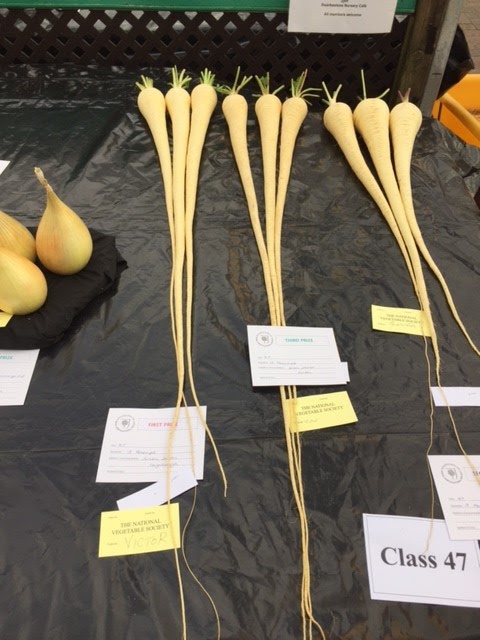
In 2015 I had the great feeling of actually winning parsnips at Malvern, nudging Andrew into a rare 2nd place. When I first started growing long parsnips nearly 20 years ago I’d never have dreamed I could have progressed from this;


To this;


As you can see my parsnips have improved nearly as much as my looks. Back then I grew them in a single plastic oil drum filled with sand, and I didn’t bother cutting the bottom off so I invariably ended up with a  root coiled at the end where it had reached the bottom of the drum and gone spiralling round. Over the years I have acquired more drums (engineering companies will often give them to you to save paying to have them disposed of) and I have extended the depth through varying methods, so that my roots have got longer and longer. Initially it was a raised bed filled with sand and the now bottomless drums placed on that. In 2012 it was noticeable that my roots were shorter than all those in the tickets, and whilst length itself is not really a consideration for the judges I came to believe good length will make them stand out and make the judges take note, so long as your roots have good quality that is. The longer they are then the longer they will fill out and taper down the root, which all adds to the effect. I also think the longer ones come out more easily, as they are so thin at soil level which is the weakest part, so they don’t snap further up the root. Just my belief.


In 2015, and before my Malvern triumph, I had also travelled up to Dundee for that season’s National Championships, a brilliant weekend at the Dundee Flower and Food Festival, where I managed a 4th place ticket in highly exalted company. Ian Stocks won again, David Thornton was 2nd and Graham Watson 3rd, all previous parsnip winners at the National, so I was in very good company. John Croot and Geoff Butterworth both felt I might have been placed even higher but I was more than happy with 4th I have to say, as you can see by my soppy grin and gay pose.


One of the big problems I’d had in previous years with parsnips were brown lesions and cavities on the skin. For years I believed this to be parsnip canker and tried to take appropriate measures, all to no avail. When you actually read up on parsnip canker it should only thrive in clay soil and hates lime. My parsnip mix is obviously quite free draining and contains lime so I could never understand why I kept suffering with ‘canker’. Over time I came to realise I was actually experiencing carrot fly damage. This looks totally different on carrot skins, with dark, deep holes and fissures that are unmistakeable. I wonder if, whilst the carrot fly grub is perfectly willing to nibble on parsnips, they only graze the surface and this rots in a different manner to carrots giving a brown appearance rather than black. Once I realised carrot fly was the culprit I was able to spray with a strong insecticide called Hallmark which you do have to go to clandestine efforts to acquire. No doubt the organic brigade will once again accuse me of killing Mother Nature but I don’t give a flying fart as for exhibition your veg has got to be in pristine condition. So, to be sure that you know, this is what carrot fly damage looks like on parsnips;


It was an incredible feeling to repeat the win at Malvern last year with an even better set, actually beating 5 current or ex-National champions in the process, proving that I had moved on to become one of the best parsnip growers in the country, something to put on my headstone for passing dogs to piss up against no doubt. I hadn’t been able to make last year’s National held in Wales due to the imminent arrival of my 3rd grandson, but fellow showman Mark Perry felt they were better than those that came 1st at the National a couple of weeks earlier, won by Andrew Jones yet again. Nice to hear, but Mark is also a Liverpool fan so you have to say he does talk a lot of bollocks a lot of the time so I am cautious.


The next step now is to try and repeat this in September this season when the National Championships of the NVS comes to Malvern on its 5 yearly cycle, which will now be my final chance at becoming a National Champion, by no means an easy feat as the top growers in the land will now be gunning for me. So I got a slightly earlier start than usual this season, taking advantage of some decent weather in March to get the chitted seeds in the boreholes. The variety I’ve grown for the past 2 years and that has served me so well is one called Victor, available from Medwyn’s. I like the way its shoulder is nicely rounded into the leaf stalk cavity making cleaning quite easy. One of my fellow competitors at Malvern asked how I got my roots so white and I admitted that I actually take the rough side of a scourer to them once I’ve got as much dirt off them as I could with a hose pipe and the smooth side of the scourer. If you want to try this method I’d strongly recommend you try on a spare first, as you do have to be quite gentle so as not to rub in deep scratches to the skin. It works for me, but I certainly wouldn’t do it on carrots or potato skins for instance. Bearing in mind you need a set of 5 at the National rather than 3 then every root will have to be top notch.


I also extended my drums yet again by adding another 9” of part drum on top, taped together with strong duct tape so ensure they don’t come apart. This will potentially give me roots up to 70” long. Risky maybe? Should I have changed a winning formula in my final season of showing? Who knows, but I just fancied having a go at getting a set that overhangs the edge of the benches, even at Malvern, by several inches. However, I would never be able to match the late, great Jack Arrowsmith. I once saw a set of his at Malvern that actually touched the floor at the foot of the bench and carried on for another few inches. They really were something else.


I ended last season winning parsnips at Dave Thornton’s show in Derby, picking up best in show with them. There were some superb exhibits grown by several top growers so to get best in show in that company was something I would only have dreamed about when I ended the blog back in 2012. As I said, a lot has happened in the last 5 years.


It has been another busy few days in the garden, dodging the heavy rain showers mostly over the weekend, then moving the hose around during this mini-heatwave we’re experiencing, but I did take a few hours out on Saturday night when I donned my black tie .....


......to attend the prestigious 2017 Trumpton Garden Book Awards, as special guest of the very camera shy Craven Morehead whose book Carrots at Dawn had been shortlisted for the 2017 overall book of the year out of all the various category winners. Other nominees were;

A Russian back garden by Onya Bakyabitch
Herbal remedies for erectile dysfunction by Don Kedick
50 great Australian gardens by Sydney Arbour
Love in the garden by Ben Doon and Phil McCavity
My Israeli garden adventures by Lemmy C. Yatitz

The judges were the esteemed garden writers Hugh Jardon and Mike Oxmells. Sadly, Craven didn’t win but he was very pleased with the judges’ comments that Carrots at Dawn had plunged garden writing to previously unplumbed depths.